English
 中文简体
中文简体
Oct 20,2026
Content
- 1 What Are Vinyl Sheet Piles and How Are They Manufactured?
- 2 Vinyl vs. Steel vs. Wood Sheet Piling: A Practical Comparison
- 3 Common Profile Types and Their Structural Implications
- 4 Primary Applications of Vinyl Sheet Piles Across Industries
- 5 Installation Methods and Equipment Considerations
- 6 Design Considerations and Quality Standards for Vinyl Sheet Piling Projects
What Are Vinyl Sheet Piles and How Are They Manufactured?
Vinyl sheet piles are interlocking structural panels made from polyvinyl chloride (PVC) compounds, designed to be driven into soil or sediment to form continuous retaining walls, seawalls, bulkheads, and erosion control barriers. Unlike steel or timber sheet piling, vinyl sheet piles are manufactured through an extrusion process in which PVC resin is blended with stabilizers, impact modifiers, UV inhibitors, and other additives, then forced through a die to produce a consistent cross-sectional profile. This extrusion process allows precise control over wall thickness, interlocking geometry, and surface texture, resulting in panels that meet tight dimensional tolerances critical for proper field installation.
The PVC compound used in high-quality vinyl sheet piles is formulated specifically for structural outdoor applications. Virgin PVC resin is preferred over recycled content for load-bearing sheet piling because it delivers more consistent mechanical properties and better long-term resistance to environmental degradation. Impact modifiers such as chlorinated polyethylene (CPE) or acrylic compounds are blended into the resin to prevent brittle fracture during installation — particularly important in cold climates where driving piles into firm ground can generate significant impact stress. UV stabilizers, typically organotin or calcium-zinc based systems, protect the material from surface degradation caused by prolonged solar exposure in above-waterline applications.
Vinyl vs. Steel vs. Wood Sheet Piling: A Practical Comparison
Choosing the right sheet pile material is one of the most consequential decisions in a waterfront or retaining structure project. Each material category has distinct strengths and limitations, and the optimal choice depends on the specific soil conditions, design loads, exposure environment, and project budget. The table below provides a direct comparison across the factors most relevant to practical project decision-making.
| Property | Vinyl (PVC) | Steel | Wood (Timber) |
| Corrosion Resistance | Excellent — immune to rust and saltwater | Poor without coating/cathodic protection | Poor — rots in wet/dry cycles |
| Service Life | 50+ years | 25–50 years (with maintenance) | 10–25 years |
| Weight | Light — easy to handle manually | Heavy — requires lifting equipment | Moderate |
| Maintenance Cost | Minimal — no painting or treating | High — periodic recoating required | High — retreatment and replacement |
| Environmental Impact | No leaching of chemicals | Rust contamination risk | Preservative chemicals leach into water |
| Load Capacity | Moderate — suitable for most light/medium loads | High — suited for heavy structural loads | Low to moderate |
For most residential, light commercial, and marine shoreline applications, vinyl sheet piles deliver the optimal balance of performance, longevity, and lifecycle cost. Steel sheet piling remains the preferred choice for heavy civil engineering applications such as deep excavation support, port quay walls, or structures carrying surcharge loads from heavy traffic or equipment — situations where the higher bending moment capacity of steel is structurally necessary.
Common Profile Types and Their Structural Implications
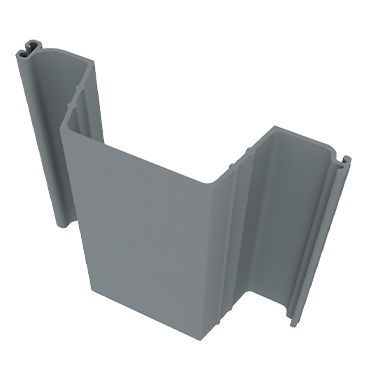
Vinyl sheet piles are manufactured in several cross-sectional profile geometries, each offering a different combination of section modulus, moment of inertia, and interlocking mechanism. Selecting the correct profile for a given application requires understanding the relationship between profile geometry and structural performance under soil and hydrostatic loading.
Z-Profile (Z-Pile)
The Z-profile is the most structurally efficient sheet pile geometry because its interlocking joints are positioned at the outermost fibers of the combined wall section — the points of maximum bending stress. This placement maximizes the effective section modulus per unit weight of material used. Z-profile vinyl sheet piles are the standard choice for bulkheads and seawalls subject to significant lateral earth pressure or wave loading. Typical section modulus values for vinyl Z-piles range from 20 to 60 cm³/m of wall width, depending on the pile's height and wall thickness specification.
U-Profile (U-Pile or Arch-Web)
U-profile vinyl piles have their interlocking joints at the neutral axis of the wall section, which reduces their effective section modulus compared to equivalent Z-piles. However, U-piles are easier to pitch and drive in clutch because their symmetrical geometry simplifies panel alignment during installation. They are commonly used for landscape retaining walls, garden ponds, irrigation channel lining, and other applications where bending loads are moderate and installation simplicity is prioritized over maximum structural efficiency.
Flat Web and Tongue-and-Groove Profile
Flat web vinyl sheet piles with tongue-and-groove interlocks are used primarily for cut-off walls — subsurface barriers designed to control groundwater seepage or contaminant migration rather than resist lateral earth pressure. Their flat profile minimizes soil disturbance during installation and maximizes the tightness of the interlock seal. These piles are widely used in environmental remediation projects, landfill liner systems, and low-head flood control berms where hydraulic impermeability is the primary design requirement rather than structural bending resistance.
Primary Applications of Vinyl Sheet Piles Across Industries
Vinyl sheet piles have established a strong track record across a wide range of civil, marine, and environmental construction applications. Their corrosion immunity and low maintenance requirement make them especially valuable in contexts where access for ongoing inspection and repair is limited or costly.
- Seawalls and Bulkheads: Vinyl sheet piles are extensively used in coastal and tidal waterway shoreline stabilization. Their resistance to saltwater, marine organism attack, and repeated wet-dry cycling gives them a significant service life advantage over both timber and unprotected steel in these environments. They are commonly installed along residential waterfront properties, marina berths, and navigation channel banks.
- Retaining Walls: In landscape and civil engineering contexts, vinyl sheet piles are used to construct retaining walls for road embankments, slope stabilization, and terraced garden structures. Their light weight simplifies installation with minimal equipment, making them cost-effective for projects in locations with restricted access or limited crane capacity.
- Flood Defense Barriers: Many municipal flood control programs now specify vinyl sheet pile walls for permanent or deployable flood barriers along riverbanks and urban drainage channels. The material's dimensional stability and resistance to silt and biological fouling make it well suited for structures that may be submerged for extended periods.
- Environmental Containment: Flat web vinyl sheet piles are used as subsurface cut-off walls to contain contaminated groundwater plumes at industrial brownfield sites and landfill perimeters. Their chemical resistance to a broad range of organic solvents, leachates, and petroleum products makes them superior to steel in these chemically aggressive subsurface environments.
- Aquaculture and Pond Construction: Fish farms, aquaculture ponds, and irrigation reservoir lining represent a growing application segment for vinyl sheet piles. Their non-toxic, inert surface is safe for aquatic organisms and eliminates the risk of chemical leaching into sensitive water bodies that would disqualify treated timber or painted steel from these applications.
Installation Methods and Equipment Considerations
Vinyl sheet piles can be installed using several driving methods, and the correct method selection depends on the pile profile, soil conditions, and site access constraints. Because PVC is significantly less stiff than steel, installation technique must be carefully controlled to prevent panel distortion, interlock disengagement, or splitting at the pile head during driving.
Vibratory Driving
Vibratory hammers are the preferred installation equipment for vinyl sheet piles in most soil conditions. The vibratory action liquefies the soil particles adjacent to the pile tip momentarily, reducing driving resistance without the high-impact shock loads that can damage PVC panels. A purpose-made vinyl pile clamp or follower must be used to distribute the vibratory force evenly across the pile head section and prevent localized crushing. In loose to medium-dense sands and soft to medium clays, vibratory driving can achieve penetration rates of 1–3 meters per minute, making installation highly efficient on well-organized sites.
Hydraulic Press-In Method
Press-in machines use hydraulic rams to push the sheet pile into the ground without dynamic impact or vibration. This method is ideal for sensitive urban sites where vibration could damage adjacent structures or disturb existing utilities. Press-in installation also produces no airborne noise beyond equipment operation, making it suitable for noise-restricted residential areas. The method requires a reaction force — typically provided by previously installed piles held by the machine's clamp frame — and is most effective in soft to medium soils where hydraulic force requirements remain within the machine's capacity range.
Water Jetting
In sandy or gravelly soils with high driving resistance, high-pressure water jetting alongside the pile can break up dense material at the pile tip and fluidize it sufficiently to allow the pile to be advanced by hand pressure or light vibratory assistance. Jetting must be carefully controlled in vinyl piling operations to prevent overfluidization that could cause panel misalignment or interlock separation. After the pile reaches its target depth, jetting is stopped and the loosened soil around the pile is allowed to reconsolidate, restoring passive soil resistance against the wall.
Design Considerations and Quality Standards for Vinyl Sheet Piling Projects
Structural design of vinyl sheet pile walls follows the same geotechnical principles applied to steel sheet pile walls — passive and active earth pressure analysis, embedment depth calculation, and deflection check under design loading. However, the lower elastic modulus of PVC (approximately 2,800–3,500 MPa compared to 200,000 MPa for steel) means that vinyl walls will exhibit significantly greater deflection under equivalent loading. Designers must verify that predicted deflections are compatible with the project's serviceability requirements and that the pile embedment depth is sufficient to maintain wall stability without relying on bending stiffness alone.
When sourcing vinyl sheet piles, specifiers should verify compliance with recognized material and performance standards. In the United States, ASTM D4101 covers PVC compound requirements for extruded products, and many manufacturers reference ASTM standards for mechanical property testing of their specific pile profiles. European projects typically reference EN 13383 or manufacturer-specific European Technical Assessments. Key properties to verify in supplier documentation include minimum tensile strength (typically ≥40 MPa), flexural modulus, Charpy impact resistance at low temperature, and UV weathering performance after accelerated exposure testing. Requesting independent laboratory test reports rather than relying solely on supplier datasheets is strongly recommended for structural applications where pile performance is safety-critical.