English
 中文简体
中文简体
Oct 27,2026
Content
- 1 What Vinyl Sheet Piles Are and Why Engineers Choose Them
- 2 Material Composition and How It Determines Structural Performance
- 3 Common Profile Types and Their Specific Use Cases
- 4 Vinyl vs. Steel Sheet Piles: Where Each Material Wins
- 5 Installation Methods and Practical Considerations in the Field
- 6 Critical Specification Checks Before Purchasing Vinyl Sheet Piles
What Vinyl Sheet Piles Are and Why Engineers Choose Them
Vinyl sheet piles are interlocking structural panels extruded from polyvinyl chloride (PVC) compounds and driven or pressed into soil to form continuous walls for earth retention, water control, and erosion protection. Unlike their steel or timber counterparts, vinyl sheet piles are inert to the electrochemical processes and biological activity that cause corrosion and decay, making them the dominant choice in applications where the retaining structure will be in prolonged contact with saltwater, brackish water, chemically contaminated soils, or aggressive freshwater environments.
The interlocking system — typically a tongue-and-groove or thumb-and-finger profile along both edges — allows individual sheets to be connected into a continuous wall on-site without welding, bolting, or specialized connection hardware. This ease of assembly, combined with the material's resistance to environmental degradation, has driven widespread adoption in coastal retaining walls, bulkheads, seawalls, canal linings, pond containment systems, and low-to-medium-load retaining structures across residential, commercial, and civil infrastructure projects worldwide.
Material Composition and How It Determines Structural Performance
The structural and durability performance of vinyl sheet piles is determined primarily by the PVC compound formulation and the extrusion quality of each profile. High-performance vinyl sheet piles use unplasticized PVC (uPVC) — the same rigid form used in window frames and pressure pipe systems — rather than flexible plasticized PVC. uPVC maintains its stiffness across the full range of soil and water temperatures encountered in field conditions, whereas plasticized grades soften under heat and lose their load-bearing capacity over time.
Key additives in the uPVC compound include UV stabilizers, impact modifiers, and heat stabilizers. UV stabilizers — typically organotin compounds or calcium-zinc systems — prevent photodegradation of the polymer surface under prolonged sunlight exposure, which is critical in above-waterline sections of seawalls and bulkheads. Impact modifiers, such as chlorinated polyethylene (CPE) or acrylic processing aids, increase the material's resistance to splitting or cracking during pile driving in cold temperatures or rocky soils. Well-formulated compounds maintain their mechanical properties through 50 or more years of service under normal environmental loading.
Section Modulus: The Key Structural Parameter
The structural efficiency of a vinyl sheet pile is quantified by its section modulus (cm³/m), which measures the profile's ability to resist bending moment per unit width of wall. Deeper, thicker profiles with pronounced ribs or corrugations achieve higher section modulus values. Common vinyl sheet pile profiles range from lightweight grades at 100–200 cm³/m for low-load garden and landscape applications to heavy-duty profiles reaching 500–900 cm³/m for marine bulkheads and canal walls subject to significant hydrostatic and soil pressure. Engineers use the section modulus in combination with a geotechnical analysis of retained height and soil conditions to confirm that deflection under design load remains within acceptable limits.
Common Profile Types and Their Specific Use Cases
Vinyl sheet piles are manufactured in several profile geometries, each optimized for a different balance of structural performance, ease of installation, and cost. Selecting the appropriate profile type is the first practical decision in any project specification.
| Profile Type | Section Modulus Range | Typical Retained Height | Primary Application |
|---|---|---|---|
| Flat / Low-Profile | 100 – 200 cm³/m | 0.5 – 1.2 m | Garden beds, landscaping borders, pond edges |
| Z-Profile / Corrugated | 250 – 500 cm³/m | 1.2 – 2.5 m | Residential bulkheads, stream banks, retention ponds |
| Deep Arch / Omega | 500 – 900 cm³/m | 2.5 – 4.5 m | Marine seawalls, coastal bulkheads, canal walls |
| Combination Walls (with steel H-piles) | 900+ cm³/m effective | 4.5 m+ | Port structures, heavy flood barriers |
Z-Profile Piles for Residential and Light Commercial Projects
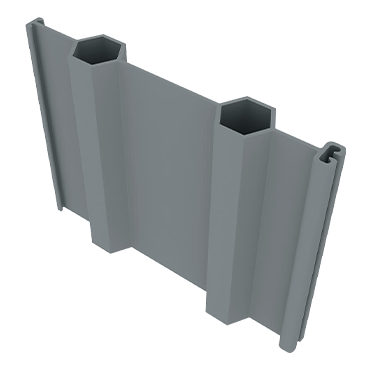
The Z-profile is the most widely specified vinyl sheet pile geometry in residential waterfront and light commercial applications. Its corrugated cross-section places material efficiently in tension and compression zones, achieving a high section modulus relative to the volume of PVC used. Standard Z-profile panels are typically 400–600 mm wide with a wall thickness of 7–12 mm in the web and 10–16 mm at the interlocks, and are available in standard lengths from 3 m to 12 m. For bulkheads retaining up to 2 m of water or soil above the mud line, properly specified Z-profile vinyl piles perform comparably to light steel sections while offering indefinite corrosion resistance.
Deep Arch Profiles for Marine and Coastal Environments
In fully marine environments — boat docks, tidal channels, estuarine waterways, and coastal flood barriers — the deep arch or omega profile provides the section modulus needed to resist both hydrostatic pressure differentials and the dynamic loading imposed by wave action and vessel wake. These profiles are typically wider (600–1,000 mm per panel) and use thicker PVC sections at the flange tips to resist the high interlock forces generated when adjacent panels are driven in sequence. The interlock itself is usually a robust thumb-and-finger geometry that maintains watertightness while allowing the slight angular tolerance needed to drive curved wall alignments on waterfront projects.
Vinyl vs. Steel Sheet Piles: Where Each Material Wins
The choice between vinyl and steel sheet piles is not simply a material preference — it is a technical decision driven by environmental exposure, structural load, project budget, and anticipated service life. Both materials have clear domains where they outperform the alternative.
Vinyl sheet piles hold a decisive advantage in environments where corrosion is the primary threat to long-term integrity. Steel sheet piles in saltwater environments lose significant section thickness to corrosion within 10–20 years without cathodic protection or aggressive coating maintenance programs. Cathodic protection systems add capital and recurring costs, and coating systems require periodic reapplication as the submerged and splash-zone sections degrade. Vinyl requires none of these interventions — the material's corrosion resistance is inherent and permanent, reducing lifecycle cost substantially in marine and chemically aggressive environments.
Steel retains its advantage in applications requiring very high retained heights — generally above 4–5 m of net soil or water retention — where the bending moment demand exceeds what practical vinyl sections can resist without supplemental anchoring systems. Steel's much higher modulus of elasticity (200 GPa vs. approximately 3 GPa for uPVC) means steel walls deflect far less under the same bending load, which matters in applications where wall movement could damage adjacent structures or utilities. For heavily loaded marine terminals, deep flood barrier systems, or large-scale infrastructure projects, steel or combination walls with vinyl infill panels remain the engineering preference.
Installation Methods and Practical Considerations in the Field
Vinyl sheet piles can be installed using several methods depending on soil conditions, available equipment, adjacent structure sensitivity, and project scale. Choosing the correct installation approach prevents both pile damage and ground disturbance that could compromise the wall's performance.
Vibratory Hammer Installation
Vibratory pile hammers are the most common installation equipment for vinyl sheet piles in granular and cohesive soils. The vibratory hammer clamps to a steel drive cap placed over the top of the pile and transmits high-frequency vibration that temporarily reduces the friction between the pile and surrounding soil, allowing the pile to be advanced to the required penetration depth under its own weight plus the static downforce of the hammer. Vibration-induced installation minimizes the impact stress on the PVC profile compared to drop or hydraulic impact hammers, reducing the risk of top-of-pile splitting or interlock damage. For sensitive sites near existing structures, vibratory installation also generates lower ground vibration levels than impact driving.
Hydraulic Press-In Systems
In urban or confined sites where vibration and noise must be minimized — adjacent to operational buildings, sensitive utilities, or in noise-restricted zones — hydraulic press-in machines (sometimes called silent pilers) advance vinyl sheet piles by static jacking force using previously installed piles as reaction. This method produces essentially zero vibration and very low noise, making it the preferred technique for urban waterfront renovations, canal wall replacements in built-up areas, and flood defense upgrades in residential neighborhoods. Press-in systems are, however, limited to sites where the required installation force does not exceed the machine's capacity, which typically constrains their use to softer or medium-density soils.
Pre-Augering in Dense or Obstructed Soils
When vinyl sheet piles must penetrate dense gravels, heavily compacted fills, or soils containing cobbles or construction debris, pre-augering a pilot hole along the pile alignment allows the pile to advance through the obstruction zone without the driving resistance that would otherwise crush or split the PVC profile. The auger diameter is kept slightly smaller than the pile width to maintain soil confinement around the final pile position. Pre-augering adds cost and time but is far less expensive than replacing damaged piles after failed driving attempts in problematic ground conditions.
Critical Specification Checks Before Purchasing Vinyl Sheet Piles
The vinyl sheet pile market includes products ranging from engineered structural profiles produced by established manufacturers with full material certifications, to commodity extrusions with unverified compound formulations and inconsistent dimensional tolerances. Specifying and procuring correctly requires scrutiny of the following points.
- PVC compound certification: Request confirmation that the PVC compound meets ASTM D4216 (Standard Specification for Rigid PVC and Related Plastic Building Products) or an equivalent recognized standard. Compounds certified to this standard have been tested for impact resistance, tensile strength, and environmental stress crack resistance.
- Section modulus documentation: The manufacturer should supply independent structural calculations or third-party test data confirming the section modulus and moment of inertia for each profile. Do not rely solely on manufacturer datasheets that have not been independently verified.
- Wall thickness tolerances: Specify minimum wall thickness at the web and interlock zones, not just nominal average thickness. Undersized interlocks fail under lateral soil pressure, causing wall sections to separate and lose water or earth retention capacity.
- UV stabilizer package disclosure: For installations with exposed above-ground sections, request confirmation of the UV stabilizer type and loading. Organotin-free stabilizer systems (calcium-zinc or organic-based) are increasingly preferred for environmental compliance in projects near sensitive water bodies.
- Length availability and tolerances: Confirm that required pile lengths are available from stock or can be produced without excessive lead time, and check length tolerances. For walls where pile tops must finish at a consistent elevation, length variation greater than ±25 mm creates additional cut-and-finish work in the field.
- Watertightness of interlock system: For applications where the wall must function as a water barrier — flood protection, pond containment, contaminated site cutoff walls — confirm that the interlock geometry has been tested for hydrostatic watertightness and that sealant or hydrophilic filler strips are available for the interlock channel if zero-leakage performance is required.
Vinyl sheet piles offer a compelling combination of corrosion immunity, installation speed, and low lifecycle cost for the broad range of retaining and water control applications where their structural capacity is adequate. Their performance over decades of service in marine, freshwater, and chemically aggressive environments has been well demonstrated across thousands of installations globally. Ensuring that the specification, product selection, and installation method are correctly matched to the project's specific conditions is what converts that inherent material potential into a structure that performs as designed for its full intended life.