English
 中文简体
中文简体
Oct 14,2026
Content
- 1 Cofferdam Design Essentials
- 2 Key Factors That Shape a Cofferdam Design
- 3 Common Cofferdam Types and Their Design Considerations
- 4 Why Material Selection Matters in Cofferdam Design
- 5 Vinyl Sheet Piles in Cofferdam Construction
- 6 Design Verification and Quality Assurance
- 7 Applying the Right Cofferdam Design Approach
When a contractor needs to build a temporary enclosure in a water body, the first question is rarely about the coffer dam's shape. It is about whether the design will hold under real field conditions. A cofferdam design that works well on paper can still fail if the soil beneath it is more permeable than the geotechnical report suggests, or if the specified sheet pile material cannot handle long-term exposure to brackish water. The practical answer for most temporary works is to prioritize three interdependent factors: site assessment, structural form, and material performance. Getting these right early reduces the risk of costly rework, schedule delays, and safety incidents.
Cofferdam Design Essentials
A cofferdam is a temporary structure that retains water and soil to create a dry work area. It allows crews to pump out the enclosed space, excavate, and build foundations, culverts, or other submerged elements safely. The design process starts by defining what the structure needs to achieve: dewatering, diversion, or simply holding back water while a permanent structure is installed. Each objective drives different geometry, wall configuration, and sealing requirements.
According to basic geotechnical principles, a cofferdam design must control two failure modes: external stability and internal stability. External stability means the wall resists sliding, overturning, and deep-seated rotational failure. Internal stability means the soil inside the retained area does not experience piping, heave, or excessive seepage that undermines the excavation. Both modes depend heavily on the soil profile, water pressure, and the wall's embedment depth.
What a Cofferdam Design Must Achieve
An effective design achieves three things simultaneously. First, it keeps water out long enough for construction to proceed. Second, it minimizes the cost of temporary works without compromising safety. Third, it is practical to install and remove within the project schedule. If any one of these is marginal, the design may still "work" in a theoretical sense but fail on the job site.
The depth of cut off is a critical parameter. It is calculated by considering the sheet piles as fixed at the bottom frame position, often with an assumed hinge at the support level. This simplified model is common in preliminary design because it gives a conservative estimate of the required pile length. But it can be refined with numerical methods or finite element analysis when site conditions are complex and the cost of overdesign is significant.
Key Factors That Shape a Cofferdam Design
Before selecting any wall type, the designer or estimator must gather specific data. The following factors are non-negotiable in a cofferdam design, and each one can change the answer by orders of magnitude.
- Soil permeability and strength: Loose sands and high-plasticity clays behave very differently. Long-term seepage through a sandy layer can cause the base to heave, while a soft clay layer may not provide enough lateral resistance for an anchored wall.
- Water depth and tidal range: A design intended for a calm lake is different from one exposed to daily tidal fluctuations or storm surges. Hydraulic loading is not static, and the wall must resist cyclic pressure changes.
- Required excavation depth: Deeper excavation increases the moments and shear forces in the wall. It also raises the need for stronger bracing or an internal support system.
- Construction sequence and access: The layout must consider how the dewatering pumps, excavation machinery, and concrete trucks will access the site. A design that requires many staged pile installations in a tight footprint adds logistical risk.
These factors are not independent. A high water table may be manageable with a single-walled solution for a one-meter deep excavation, but a three-meter excavation with soft clay at the base needs a much stiffer approach. That is why a good cofferdam design is always site-specific, not a generic template.
Common Cofferdam Types and Their Design Considerations
Cofferdams come in several forms, each with distinct advantages and limitations. The choice depends mostly on the environment, the depth of water, and the duration of the work. Below is a comparison of the primary types used in modern construction as an overview, not as a specification. A qualified engineer should always review the final design for the actual site conditions.
| Cofferdam Type | Typical Use | Key Design Considerations |
|---|---|---|
| Earthen | Shallow water, low permeability soils | Requires large footprint, drain-down risk in sandy soils, limited to low head differences. |
| Single-walled sheet pile | Dewatering and excavation up to several meters deep | Anchor or bracing needed; saturation of the retained soil and base heave must be assessed. |
| Double-walled sheet pile | Deep water or where dry working space is needed | Interior fill can add stability but increases load on the wall; full saturation of fill must be considered. |
| Cellular | Marine and large-scale waterfront construction | Consistent cell size simplifies analysis; evaluation must include saturation of cell fill and variations in hydraulic head. |
| Inflatable | Low head barriers, spillway dewatering | Quick to install but limited height; requires stable foundation and careful anchoring to prevent uplift. |
Design recommendations for cellular cofferdams emphasize that all cells should be the same size. This consistency makes the analysis more reliable because stress distribution is easier to predict. If one cell is significantly different in dimension or fill characteristics, it creates a local zone where the design assumptions no longer hold. For any cellular wall, the effect of full saturation of the cell fill must be evaluated. A partially saturated fill can behave differently under repeated wetting and drying, which affects both the internal stability and the wall's overall stiffness.
Why Material Selection Matters in Cofferdam Design
Once the structural solution is defined, the next decision is the wall material. In many projects, steel sheet piles are the default choice. They have high strength and a large installed base, so many engineers are accustomed to designing with them. But steel is heavy, requires coating or cathodic protection to resist corrosion in marine environments, and its weight makes transport and handling expensive on remote sites.
Wood and concrete have historical use as well. Wood is lightweight but limited in service life and strength. Concrete is strong and durable but very heavy, which complicates both installation and removal. In a temporary cofferdam, the ability to retrieve and reuse the wall components can make a material far more economical over the life of the project, not just on initial cost.
Recent projects are also paying closer attention to the environmental footprint of temporary works. Steel production is relatively carbon intensive. If the cofferdam is only needed for a few months, the embodied energy in a heavy steel wall is hard to justify. Lighter materials that can be reused multiple times are becoming more attractive, especially when the design margin does not require the full stiffness of steel.
There is another consideration that often gets overlooked in the design stage: installation tolerance. A material that can be driven or vibrated without damage, even on uneven ground, shortens the installation window. It also reduces the risk of wall damage during extraction, which matters if the piles are meant to be reused on a later phase or another project. Those practical details are what separate a good design from one that is merely technically feasible.
Vinyl Sheet Piles in Cofferdam Construction
 Vinyl Sheet Piles for Cofferdam and Seepage ControlThese interlocking PVC profiles resist corrosion and chemical attack, making them suitable for ecological barriers and small watershed projects where installation tolerance and reuse are practical concerns.View Product →
For cofferdam applications where the design head is moderate and the primary concern is corrosion resistance or environmental impact, vinyl sheet piles offer a compelling alternative. These are extruded polymer profiles that interlock to form a continuous wall. They have become increasingly common in small watershed management, anti-seepage barriers, and ecological protection projects in water environments. The material is resistant to acids, alkalis, and saltwater attack, which is a genuine advantage over unprotected steel.
The weight difference is significant. Vinyl sheet piles can be several times lighter than an equivalent steel profile. This means easier handling on site, lower transport costs, and the ability to use lighter installation equipment. In a cofferdam design, this can translate into a smaller crane, a faster crew, and less disruption to the surrounding environment.
Durability is another practical benefit. A vinyl wall does not require field welding, bolting, or coating. It does not rust or spall. For a temporary structure, this means the piles can be extracted and reused many times without refurbishment. For a permanent or semi-permanent structure, it removes the need for periodic maintenance that would otherwise be required with steel. Vinyl also has a relatively low carbon footprint compared with steel, which is a selling point when the project owner is tracking sustainability targets.
However, vinyl sheet piles have lower section modulus than steel of comparable width. Their selection in a cofferdam is not a like-for-like substitution. The designer must confirm that the installed wall will resist the actual moments and shear forces for the site-specific excavation. In shallow to moderate depth scenarios, vinyl can perform well, especially with an appropriate bracing system. In deep, wide excavations with soft soils, steel or a composite approach may still be preferable.
Design Verification and Quality Assurance
Even the best design is only as good as the production quality of the piles. Wall interlocks must be dimensionally consistent so that the wall fits together smoothly and maintains a low-permeability joint. If the interlock is too loose, sediment can migrate through the wall, making dewatering difficult. If it is too tight, installation becomes slow and the piles may be difficult to extract later.
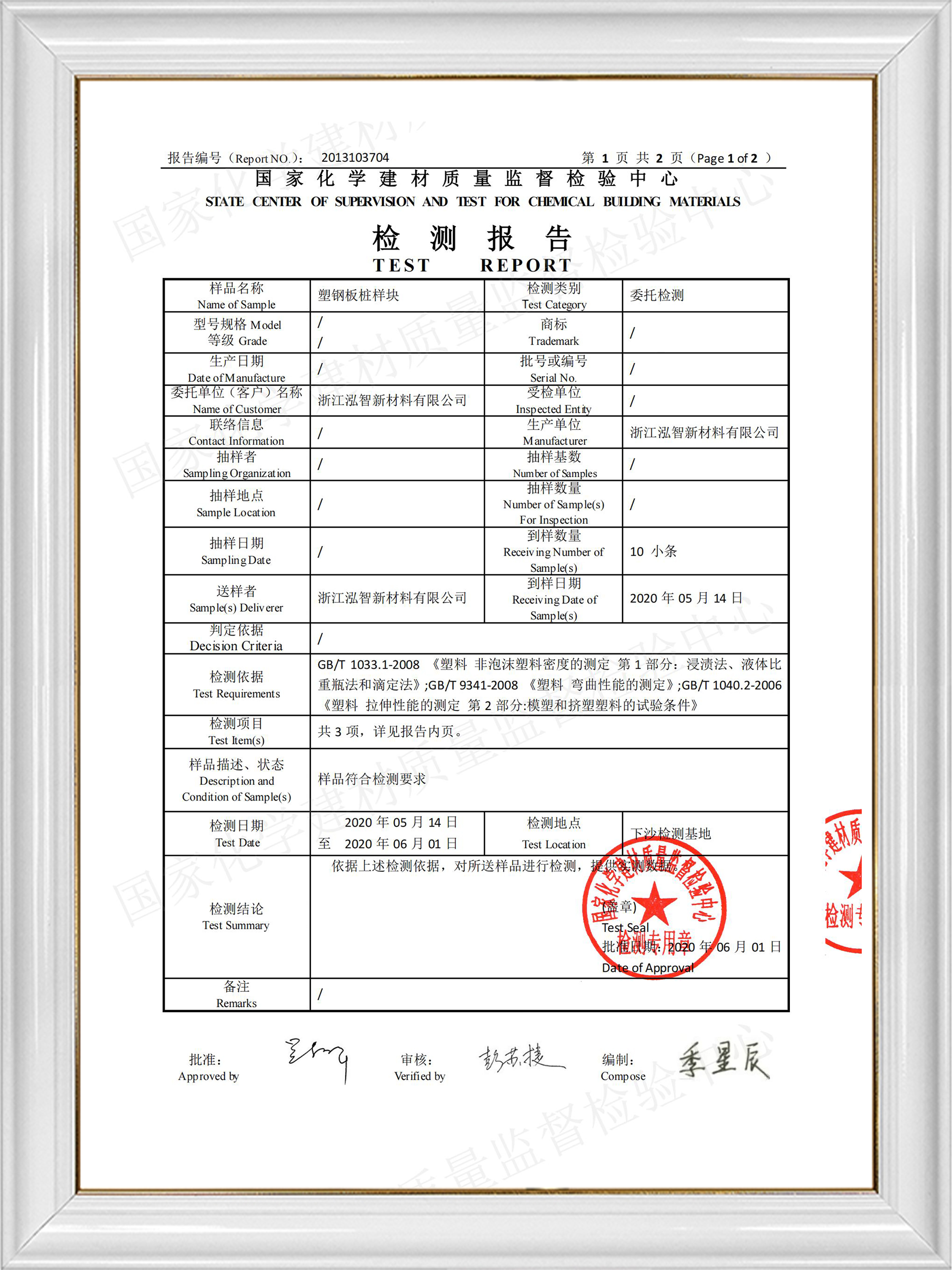
A responsible supplier will provide traceable test results. The design engineer should request data on the profile geometry, the shear strength of the interlock, and the material's resistance to UV exposure and chemical attack. For critical projects, the designer may also require a sample of the profile for a fit and performance test. A good production plant with a testing laboratory gives the designer confidence that the delivered piles will match the assumed properties in the design. It is worth investing time in this verification at the design stage, because a failed interlock during installation is far more expensive than a substitution approved upfront.
Hydrastatic and seepage issues are minimized when the wall is installed with a proper seat into the underlying soil. The design should account for the needed embedment depth to prevent seepage under the wall. The required depth of the cut off is found by considering the piles to be simply supported at the bottom frame position with a hinge assumption at the support. This model provides a safe basis for determining the wall length when exact soil parameters are uncertain.
Applying the Right Cofferdam Design Approach
Cofferdam design is an exercise in risk management. The engineer balances cost, schedule, and safety against available data. The best approach is one that aligns the wall type and material with the actual site conditions, not with a generic preference. A small stream crossing with shallow water and sandy soil may be perfectly served by a light vinyl sheet pile wall. A large river barrage with deep water and high hydraulic gradient may need a cellular steel structure. Both solutions are valid — the designer just has to know where one type stops being appropriate and the other becomes necessary.
For teams exploring a lightweight, corrosion-resistant option, the key is to incorporate the material properties early in the design process. Do not treat it as a fallback if steel is not available. Instead, use it as an intentional choice based on a clear comparison of performance, installation practicality, and total project cost. When the site allows for it, vinyl sheet piles can provide a real advantage. That is why the topic of material selection belongs in the initial design conversations, not at the procurement stage.
What is the most practical first step? Many designers start by mapping the water depth, soil profile, and required excavation. Once those are established, it becomes much simpler to narrow down the wall type. From there, the material question can be answered with data rather than habit. That is a better path for every project, no matter the size.